


CLIA-certified, CAP-accredited
Analyzed in a high-complexity andrology laboratory
WHO 6th Edition (2021) methodology
Most recent WHO semen analysis standard
Active Cooling transport
Validated sample transport, preserved until analysis
Results in 24 hours
With MateIQ interpretation included
Order. Collect. Ship. Understand.

Order your kit
Your at-home semen analysis kit ships in discreet packaging, no appointment or clinic visit required.
Collect from home
Follow the simple instructions and collect in your own space, on your own schedule.
Ship your sample
Drop off your pre-labeled kit at FedEx. Your sample ships Priority Overnight to our CLIA-certified, CAP-accredited lab, while Active Cooling helps maintain it below 15°C for up to 34 hours in transit.
Results + MateIQ
Results are delivered in 24 hours through your secure portal, with MateIQ to help explain your report and help you prepare questions for your physician.
Your Guide to Using Our
At-Home Fertility Test Kit
▶ Watch Instruction Video
Choose the level of insight you need

At-Home Comprehensive Semen Analysis
The starting point for male fertility evaluation.
Best for couples beginning the fertility journey, or if your partner has already started testing. More semen parameters than your typical semen analysis.
- 20 clinical semen parameters
- FedEx Priority Overnight shipping included
- Validated specimen transport (Active Cooling)
- Simplified patient report & physician lab report
- MateIQ - AI-powered report interpretation
- Results in 24 hours
At-Home Advanced Semen Analysis
For couples who want additional sperm quality testing.
Best for couples who have been trying without clear answers, are exploring IUI or IVF, or want the most complete semen analysis option.
- DNA Fragmentation Index – genetic integrity
- Vitality testing – % of live vs. non-viable sperm
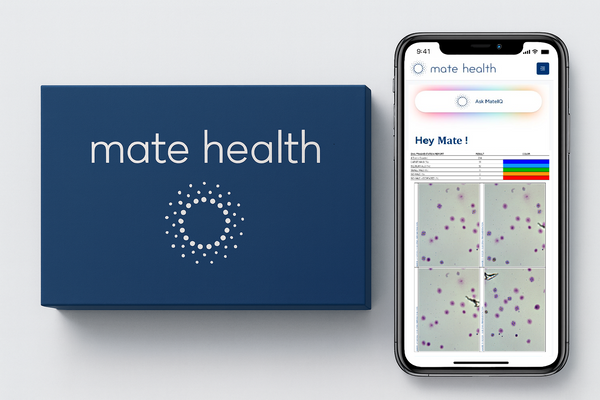
- Sperm microscopy images for physician review

At-Home DNA Fragmentation Test
For those who have already completed a semen analysis.
Best for recurrent pregnancy loss, unexplained infertility after a normal result, or physician-requested DFI testing.
- DNA Fragmentation Index – % of sperm with fragmented DNA
- Sperm Chromatin Dispersion (SCD) method
- Sperm microscopy images and videos for physician review
Haven't had a semen analysis? Choose Comprehensive or Advanced first.

Frequently Asked Questions
Find answers to common questions about our products, services, and policies.
Frequently Asked Questions
What does the Advanced At-Home Semen Analysis include that Comprehensive does not?
The Advanced At-Home Semen Analysis reports all 20 parameters from the Comprehensive analysis, plus two advanced markers: DNA fragmentation index and vitality testing. It also includes sperm microscopy images for physician review, giving you and your physician a more complete evaluation.
What is sperm DNA fragmentation, and why does it matter?
DNA fragmentation measures damage to the genetic material sperm carry, something sperm count, motility, and morphology cannot reveal on their own. It is most often considered in cases of unexplained infertility, recurrent pregnancy loss, or when assisted reproduction is being planned. Up to 20% of men with unexplained infertility and normal routine semen parameters may have elevated DNA fragmentation.
What does sperm vitality testing add?
Vitality testing measures the percentage of live sperm in a sample. When motility is low, it helps show whether non-moving sperm are alive or non-viable, useful clinical context that motility alone does not provide. Vitality results are reported with microscopy images for physician review
Who should consider the Advanced test over Comprehensive?
Some men choose Advanced from the start for the most complete picture. Others come to it after a normal result that leaves questions unanswered. It is frequently considered in cases of unexplained infertility or recurrent pregnancy loss, situations where DNA fragmentation and vitality can add context. Whether it is right for you is a decision to make with your physician.
Why does Advanced include sperm images for physician review?
Microscopy images let a physician see the sample directly rather than relying on numbers alone. For markers like morphology and vitality, visual confirmation adds transparency and supports physician interpretation of your results.
What type of sperm DNA fragmentation test does Mate Health use?
Mate Health uses the Sperm Chromatin Dispersion method, also known as the SCD or Halo test, to measure sperm DNA fragmentation and calculate the DNA Fragmentation Index, or DFI. Testing is performed using the FDA-cleared Medical Electronic Systems SQA-Vision platform, with sperm classified according to the five halo categories described in the WHO 6th Edition.
DNA fragmentation testing is included with Mate Health Advanced Semen Analysis. Patients collect at home, and testing is performed in a CLIA-certified, CAP-accredited high-complexity andrology laboratory.