

Laboratory DFI testing,
collected at home.
Sperm DNA fragmentation testing provides information on DNA integrity beyond count, motility and morphology. Mate Health pairs home collection with automated Sperm Chromatin Dispersion (SCD) analysis in the laboratory. The studies that follow show how it performs under defined cooled transport and storage conditions, and how consistently it measures.
At-Home DNA Fragmentation Test
Standalone DFI % with the 30% reference cutoff, plus sperm microscopy images and videos.
Advanced Semen Analysis
22 parameters: 20 core semen parameters plus DNA fragmentation and vitality.
Analytical validation data on file from Medical Electronic Systems, manufacturer of the SQA-Vision analyzer and QwikCheck DFI Kit used by Mate Health. CV, coefficient of variation.
Validated transport conditions, maintained by Active Cooling.
Paired laboratory testing: DFI stable through 36 hours below 15°C (60 specimens, 3 sites).
Kit sensor data: After gradual initial cooling, temperatures remained below 15°C through 36 hours.
y: DFI at 36 hours, %
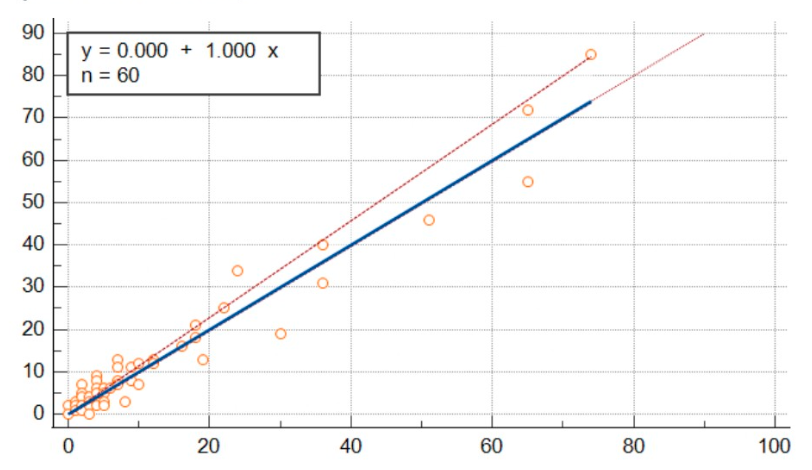
x: DFI at baseline, %
Solid line: Passing-Bablok fit. Dashed line: upper 95% confidence limit.
Each specimen was tested at baseline by Sperm Chromatin Dispersion (SCD) with automated analysis, held 36 hours below 15°C in the proprietary semen preservative used in Mate Health kits, then retested as its own control.
Same classification. Every specimen above 30% at baseline stayed above it, and 98.1% of those below 30% stayed below.
Proprietary semen preservative. Used in every Mate Health kit. Testing showed it does not meaningfully change DFI results compared with the standard laboratory diluent.
PPA/NPA: positive/negative percent agreement with baseline classification at the 30% DFI cutoff. Separate datasets. DFI: Sperm Chromatin Dispersion (QwikCheck DFI Kit, SQA-Vision automated analysis) under controlled storage conditions; data on file from Medical Electronic Systems. Temperature: Mate Health kit validation sensor data through 36 hours; DFI was not measured.
Automated DFI agrees with manual SCD.
Each specimen was measured twice: by automated DFI analysis, and independently by a different trained technologist using manual Sperm Chromatin Dispersion (SCD), the reference method. Testing ran at three sites with three external operators, three analyzers and three DFI kit lots, so agreement reflects routine variation between labs, people, instruments and reagents. Agreement was assessed by Passing-Bablok regression against predefined acceptance limits.
y: automated DFI, %
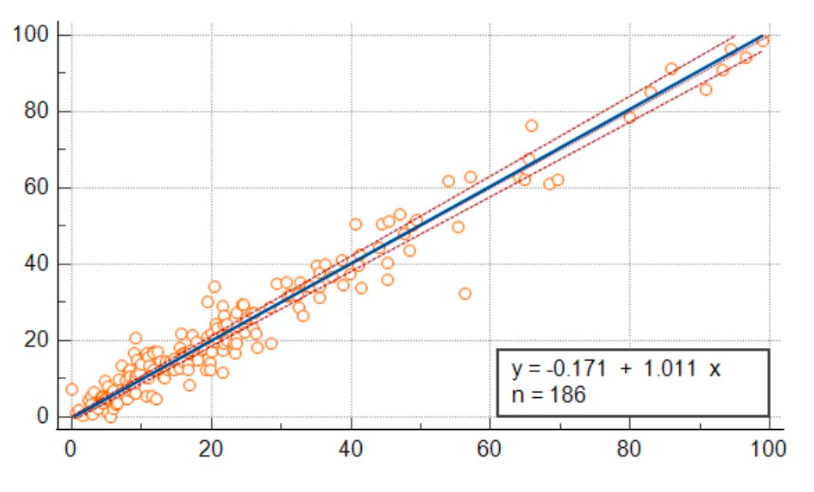
x: manual SCD DFI, %
Solid line: regression fit. Dashed lines: 95% confidence limits.
Shaded: acceptance range 1.0 ± 0.2. Line at 1.0 = perfect proportional agreement.
| Site | n | Slope (95% CI) | Intercept (95% CI) | r (95% CI) | PPA | NPA |
|---|---|---|---|---|---|---|
| Site A | 63 | 1.01 (0.96, 1.08) | −0.16 (−1.41, 0.98) | 0.96 (0.94, 0.98) | 94.7% | 97.7% |
| Site B | 64 | 0.99 (0.95, 1.04) | −0.45 (−1.34, 0.80) | 0.96 (0.94, 0.98) | 94.4% | 97.8% |
| Site C | 59 | 1.03 (0.95, 1.11) | 0.03 (−1.42, 1.22) | 0.94 (0.91, 0.97) | 100.0% | 97.8% |
| Overall | 186 | 1.01 (0.98, 1.05) | −0.17 (−0.99, 0.31) | 0.95 (0.94, 0.96) | 96.0% | 97.8% |
| Acceptance | 1.0 ± 0.2 | 0.0 ± 5.0 | 0.9 ± 0.1 | ≥90% | ≥90% |
PPA/NPA: positive/negative percent agreement with manual SCD classification at the 30% DFI cutoff. SCD, Sperm Chromatin Dispersion. WHO 6th Edition (2021) collection. Data on file from Medical Electronic Systems: SQA-Vision automated DFI vs. manual QwikCheck DFI Kit (SCD).
All predefined acceptance criteria met.
Complete validation record
| Study | Design | Result (acceptance) | Status |
|---|---|---|---|
| Method comparison | 186 specimens, 3 sites, vs. manual SCD | Slope 1.01, r 0.95, PPA 96.0%, NPA 97.8% | Met |
| Transport, 36 hours | 60 paired specimens, 3 sites, below 15°C | Slope 1.00, r 0.91, PPA 100%, NPA 98.1% | Met |
| Repeatability | 240 replicates, 3 operators, 3 analyzers, 3 lots | Total CV ≤16% (≤20%) | Met |
| Reproducibility | 216 replicates, 3 sites, 3 operators per site | Total CV ≤15% (≤20%) | Met |
| Reference interval | 126 healthy men, 3 sites, CLSI EP28-A3c | Upper limit 30% DFI (95% CI of the limit, 28–31%) | Established |
| Stability | 3 DFI levels, 9 replicates, 2, 4 and 8 days | 7 days per study conclusion; bias ≤2.7 points (≤10) | Met |
| Interference | 19 substances, 38 specimens, low and high DFI | Shift ≤5 points (≤10) | Met |
| Matrix validation | 3 matrices vs. kit diluent, 3 levels | Bias ≤4.8 points (≤5) | Met |
Collection
At home, shipped the same day by FedEx overnight.
Results
Within 24 hours after the laboratory receives the specimen.
Physician report
Full laboratory report with sperm microscopy images and videos.
Patient price
DFI $299. Advanced Semen Analysis $440.