


CLIA-certified, CAP-accredited
Analyzed in a high-complexity andrology laboratory
WHO 6th Edition (2021) methodology
Most recent WHO semen analysis standard
Active Cooling transport
Validated sample transport, preserved until analysis
Results in 24 hours
With MateIQ interpretation included
Order. Collect. Ship. Understand.

Order your kit
Your at-home semen analysis kit ships in discreet packaging, no appointment or clinic visit required.
Collect from home
Follow the simple instructions and collect in your own space, on your own schedule.
Ship your sample
Drop off your pre-labeled kit at FedEx. Your sample ships Priority Overnight to our CLIA-certified, CAP-accredited lab, while Active Cooling helps maintain it below 15°C for up to 34 hours in transit.
Results + MateIQ
Results are delivered in 24 hours through your secure portal, with MateIQ to help explain your report and help you prepare questions for your physician.
Your Guide to Using Our
At-Home Fertility Test Kit
▶ Watch Instruction Video
Choose the level of insight you need

At-Home Comprehensive Semen Analysis
The starting point for male fertility evaluation.
Best for couples beginning the fertility journey, or if your partner has already started testing. More semen parameters than your typical semen analysis.
- 20 clinical semen parameters
- FedEx Priority Overnight shipping included
- Validated specimen transport (Active Cooling)
- Simplified patient report & physician lab report
- MateIQ - AI-powered report interpretation
- Results in 24 hours
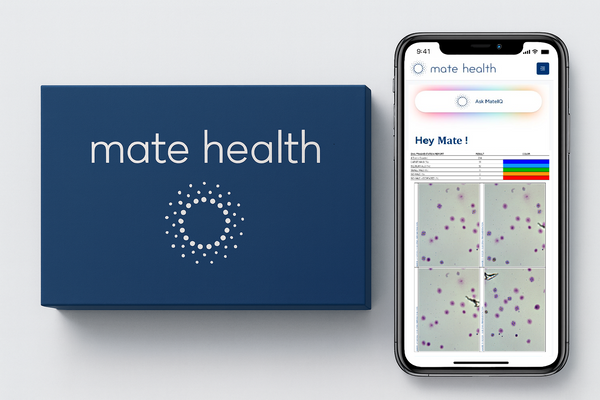
At-Home Advanced Semen Analysis
For couples who want additional sperm quality testing.
Best for couples who have been trying without clear answers, are exploring IUI or IVF, or want the most complete semen analysis option.
- DNA Fragmentation Index – genetic integrity
- Vitality testing – % of live vs. non-viable sperm
- Sperm microscopy images for physician review

At-Home DNA Fragmentation Test
For those who have already completed a semen analysis.
Best for recurrent pregnancy loss, unexplained infertility after a normal result, or physician-requested DFI testing.
- DNA Fragmentation Index – % of sperm with fragmented DNA
- Sperm Chromatin Dispersion (SCD) method
- Sperm microscopy images and videos for physician review
Haven't had a semen analysis? Choose Comprehensive or Advanced first.

Frequently Asked Questions
Find answers to common questions about our products, services, and policies.
Frequently Asked Questions
What does the Comprehensive analysis measure?
It reports 20 clinically relevant parameters from a single at-home collection, including concentration, total sperm count, the four motility classifications, morphology, velocity, and 10 calculated parameters such as functional sperm concentration. Each specimen is analyzed in a CLIA-certified, CAP-accredited andrology laboratory using WHO 6th Edition methodology.
How is this different from a standard semen analysis?
A standard semen analysis typically reports a handful of core measures. Comprehensive reports the four motility classifications separately and adds calculated parameters that show what individual numbers cannot show on their own, giving you and your physician a fuller picture.
How long do results take?
Results are available in 24 hours, with MateIQ interpretation included.
Do I need an appointment?
No. You collect at home and ship the specimen back using the provided Active Cooling transport system. No clinic visit is required.
Can I add vitality testing?
Yes. Vitality testing can be added at checkout for $45 and is reported with microscopy images. If motility is low, vitality testing helps show whether non-moving sperm are alive or not viable.